1. Botanical Characteristics
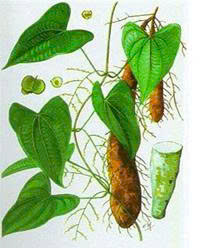
- A climbing vine with a smooth, slightly angular stem and red edges.
- Leaves are simple, alternate or opposite, heart-shaped, pointed at the tip, smooth, 8-10 cm long and 6-8 cm wide, with 5-7 veins, and a petiole 1.5-3.5 cm long.
- Inflorescences are racemes in the leaf axils, consisting of many small yellow flowers; male and female flowers are on separate plants. The male inflorescence is 40 cm long, and the curved female inflorescence is 20 cm long. The perianth has 6 equally long lobes and 6 stamens.
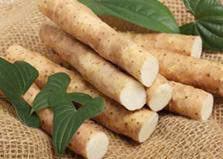
- The tuber forms from a cluster of radial roots, is cylindrical and grooved at the bottom, and is 30-50 cm long.
2. Medicinal Value
- Part used: The tuberous root.
- Uses: In traditional medicine, wild yam is considered a tonic, treating spleen and stomach weakness, poor digestion, malnutrition in children, chronic enteritis, persistent diarrhea, lung weakness, cough and asthma, diabetes, nocturnal emissions, spermatorrhea, urinary incontinence, kidney failure, back pain, frequent urination, leucorrhea, dizziness, blurred vision, and night sweats.
Daily dosage: 10g - 20g, in decoction or powder form.
3. Cultivation Techniques
3.1. Selecting the Growing Area
Wild yam can be grown in mountainous, hilly, and lowland areas. The soil needs to be fertile, rich in humus, with a cultivation layer of 20-30 cm or more.
Choose alluvial soil along rivers, sandy loam, and light clay soil with a pH of 6.6-7.5. Avoid planting in heavy clay soil or waterlogged areas. It can be grown at altitudes from 100 to 800 meters above sea level. The suitable temperature is 20°C – 35°C, and humidity is 80-95%.
3.2. Varieties and Propagation Techniques
Asexual propagation methods yield the highest propagation rate; therefore, in practice, farmers should use this method. Propagation technique: Both tubers and bulbs growing on the stem are used for propagation. When harvesting, select medium-sized tubers with smooth, light-colored skin, straight, and free from pests and diseases. It is best to use the root tip, but the lower part (the entire tuber) can also be used. Cut the tubers into 5-6 cm long sections, immediately apply lime or ash, let them dry, and then plant them immediately. Alternatively, they can be germinated in moist sand until sprouts appear before planting.
Sprouting method: Spread a 2-3 cm thick layer of sand, arrange a layer of seed tubers, and then cover with another layer of sand. 2-3 layers can be arranged in this way. After 7-10 days, the root sections will sprout and be ready for planting. The root tips sprout faster, so separate them to prevent breakage. ecoone
3.3. Planting Season
Dioscorea opposita is best planted after the Lunar New Year.
3.4. Soil Preparation Techniques
- The soil should be thoroughly plowed and harrowed, weeds removed, and the soil can be sterilized with lime powder at 130 kg/ha.
- Raised beds should be 30 cm high and 50-60 cm wide. Dig planting holes in two staggered rows and apply base fertilizer to each hole.
3.5. Planting Density and Spacing
Intensive cultivation:
- Planting density: 110,000 plants/ha.
- Planting spacing: 30 x 30 cm.
Intercropping with other crops or forestry trees, near forests: 300-500 plants/ha. ecoone
3.6. Fertilization and Fertilization Techniques
Fertilization Period: Base fertilization: Before planting, early spring.
First top dressing: 3 months after planting.
Second top dressing: 6 months after planting.
Fertilizer quantity/ha: Base fertilization: 1 ton of well-rotted manure, 30 kg of urea, 100 kg of superphosphate, 50 kg of potassium chloride, and 30 kg of NPK 13:13:13; Top dressing: 30 kg of urea, 30 kg of potassium chloride, and 35 kg of NPK 13:13:13.
3.7. Planting and Care Techniques
Plant seedlings that meet the standards in the field, water and maintain sufficient moisture until the shoots turn green. 15-20 days after planting, build a trellis for the plants. The trellis can be a roof-style or straight trellis. The higher the yam vines climb, the better the tubers will develop.
3.7. Weeding and tilling should be done one month after planting, ensuring the field is always free of weeds. When it rains, drain the water promptly to prevent flooding. Weeding should be combined with fertilization.
3.8. Pest and Disease Control
Dioscorea plants are rarely affected by pests and diseases. Aphids and stink bugs may appear, but they generally do not affect the normal growth and yield of the plant.
The plant is very susceptible to root rot if the planting field is low-lying and the soil is too wet. Prevent root rot by choosing a high-lying field, managing irrigation water appropriately, and draining water promptly during heavy rains.
3.9. Harvesting, Processing, and Storage
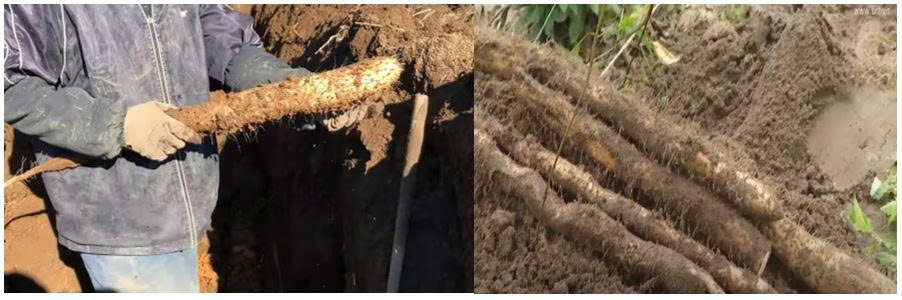
Harvesting: Dioscorea is harvested in November-December. When the plant withers, harvest the roots, cut off the stems and leaves, and dig up the tubers. Cut off the root tips for planting, and process the rest. The dry-to-fresh ratio is approximately 1:4, with an average yield of 3-5 tons of dried tubers.
Preparation: Dig up mature tubers, wash them thoroughly, peel them, and soak them in alum water to remove the mucilage (10g alum/1 liter of water) for about 2-4 hours. Remove, wash thoroughly, and place in a sulfur drying oven until the tubers are soft. Dry or dehydrate them. Continue sulfur drying for 20 hours. Dry or dehydrate at a temperature of 50°C - 60°C until the moisture content is no more than 12%.
Storage: Store in a dry place, protected from insects, mold, and pests.
3.10. Economic Efficiency
With a planting density of 3000-5000 plants/hectare under the canopy of sparsely vegetated or planted forests, after one year, each plant can yield at least 2kg of tubers, with an expected yield of 7-10 tons/hectare. At an average price of 15,000 VND/kg, this will provide a good income.
ECOONE.VN
Address
Office: Landmark 81 Building Vinhomes Central Park
720A Dien Bien Phu Street, Ward 22, Binh Thanh District, Ho Chi Minh City
Assembly Workshop
ECO G9 SCIENCE COOPERATIVE
Phuoc Dong Commune, Go Dau District, Tay Ninh Province
Phone 0935 193 151 E-mail : antoanvn1@gmail.com






 0935 193 151
 cdlkhanh@gmail.com